Categories
messaging positioning Strategy tone of voice

The importance of being modest

The case for toning down your claims to delivering business benefits

A very short history of “features vs benefits”

To start off, I want to make clear that I think it’s excellent advice. Here’s the thinking behind it:

Traditionally, tech companies, and especially those with techie founders, tend to focus on product features in their messaging. And while features are one of the most obvious ways to differentiate from the competition, leading with them in marketing comms brings a whole raft of problems:

  • Budget: The only people who quickly understand (and most naturally care about!) a feature are other techies: engineers with deep domain expertise. They are not usually the people with the budget who make purchasing decisions (but they may be important influencers)
  • Relevance: The people who do have the budget are rarely deep subject matter experts – they need help understanding why a feature matters, and why they should care about it. They need it framed as a benefit to avoid a “so what?” reaction
  • Readiness: At an early stage in the sales cycle – when buyers are gathering information and educating themselves – it’s usually too early to talk differentiation on features. The problem at this stage is winning trust by showing you understand your buyers’ world, and articulating the problem you solve for them (such as delays, or error rates, and their impact on the business). Your marketing job at this stage isn’t to sell – it’s to convince the buyer that they need a solution in the first place. It’s only at a later stage that you’ll show them that your solution is different, and better.

So that’s, roughly, where this best-practice advice comes from: to help techie people frame their product as a business solution rather than a technological one. And to show why your solution matters to more people than just its techie users. That’s why, in messaging frameworks, you often see diagrams like this, that ladder up features to benefits (and align them to buyer personas):
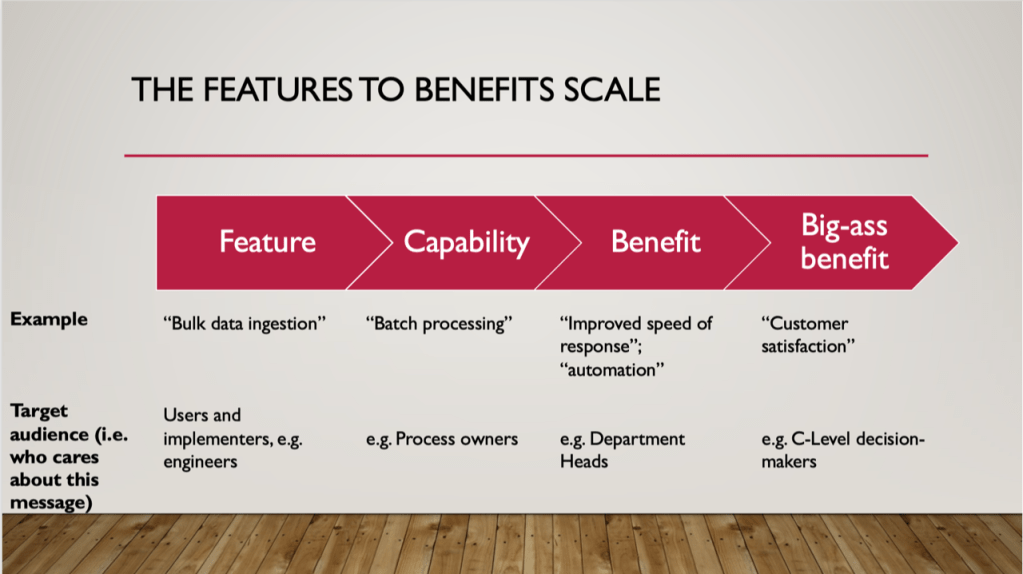
A diagram showing a scale of features to capabilities to benefits to big benefits
This is a very simplified model. For complex products and organisations, you’ll often find many more steps – but it serves to illustrate my point.
The credibility issue

One of the key strengths of this approach has to do with credibility: buyers don’t generally question a vendor’s ability to deliver on a feature, but they may be highly sceptical of lofty claims to a big-ass business benefit (or BABBs, as I lovingly call them). So showing how a feature ladders up to a benefit is a good way to give substance to your claim.

But, I wouldn’t be me if I didn’t have some reservations about the validity of this as universal best practice. As I said above, I don’t think this advice is for everyone. 

The case for modesty

I believe that for a significant number of tech vendors and their products (and especially slick digitally-first startups that haven’t been founded by techies), it pays to be modest: first of all, because claims can be tenuous if not backed up by really solid data (eg “improved customer experience” means nothing if you don’t have the NPS score or something similar to prove it); and secondly, the higher you aim with your BABB (e.g. “Competitive Advantage”), the more abstract you become – and risk claiming everything, and therefore nothing at all. So you need to decide which sort of selling personality you want associated with your brand: data-driven or visionary (I’ll write something about this soon).

And I can think of a few concrete cases when your messaging definitely shouldn’t go all the way to C-Level benefits:

  • When the C-Suite isn’t part of the purchasing decision. I know many clients don’t like to hear this (everyone wants to target the CEO these days!), but be realistic: if you’re not selling mission-critical enterprise systems that can seriously claim strategic relevance, you may have to accept that the CEO will never know that you and your product exist. They may completely delegate the buying process to their IT, user, and procurement departments and ultimately only sign off on the purchase.
  • When you sales team can’t deliver the story: Features-to-benefits messaging is about getting the altitude right and understanding the complexity and nuances of each department involved. A really great sales person can tell the right story to each customer persona AND connect it all to a big business goal, too. It’s a rare skill and not all sales teams can deliver on it. If they can’t, aiming for something like “competitive advantage” in your messaging is likely to feel like overclaim or fluff to your prospects.
  • When you’re in danger of neglecting the core buyer. It’s usually not a good idea to approach an engineer with a big business vision (unless they’re the sort of ambitious go-getter every marketer hopes for but rarely encounters); just like you’re likely to bore a CEO stiff with talk about APIs. On a recent project I worked on, the core buyer was a Head of Digitalisation for HR. As I interviewed them about their challenges, I kept probing for things like “retention rates” and “employee satisfaction”, but they kept talking about inefficient processes. The lesson: If I were to try to sell anything to this person, I’d have to frame it in terms of process improvement, not something bigger and more abstract – or I’d probably lose their interest.
Focus on your best prospect and empower them instead

In all of these cases, it’s a much better strategy to optimise your messaging for your core buyer persona (e.g. the department head) and focus on the benefits and KPIs they care about. I’d recommend having your C-level messages in the back pocket and bringing them up in one-on-one sales conversations rather than in your marketing materials.

And: it’s always a good idea to create a piece of content that enables your champions to sell internally – such as

  • An overview of talking points broken down by buyer group functions
  • A business case template
  • An interactive ROI calculator

Or maybe they’ll ask you for a specific format they know their decision-maker will like. Indulge them and have your marketers fix one up. Having an internal champion deliver your message in your stead to the C-Level is usually much more successful than a direct sales pitch.

TL;DR: stay modest, retain credibility, remain relevant

I want to emphasise that modesty is different from lack of confidence: as a tech brand and product, you should definitely know where you play and confidently claim your space in your market. That includes knowing how you can drive business success for your customers.

But in many cases, the real skill is identifying the core decision-maker first (hint: it’s probably not the CEO!), then aligning your claims to their goals and KPIs. When you do that, good things will happen:

  • You’ll speak to their needs and pain points
  • You’ll credibly show how your solution makes their life easier
  • You’ll demonstrate how you can positively impact the KPIs they themselves are measured on
  • You’ll forge a more natural and credible path to the decisoino-makers

By convincing the key person thoroughly rather than doing a half-arsed job across the board, you ultimately stand a much better chance of selling. This is quiet confidence and it goes a long way.

Categories
content marketing Marketing agencies positioning Strategy

A case study

I worked with a Brilliant copywriting agency to redefine their content strategy

I’ve written tons of case studies for clients, and blog posts on why case studies suck, and presentations full of ideas on how to make them better. But I’ve never done one for my own business – until now.

Is it the best case study I’ve ever written? Probably not. Does it avoid all the mistakes other case studies make? Definitely not. Does it have gazillions in revenue attributed to my work ? Also no. (Not yet, anyway.) But is it for one of the loveliest, most responsive, excitable and great-at–their-jobs clients a consultant could wish for? Absolutely.

Everyone, meet Radix:

Click the link to open the file in a new tab and read it more comfortably

(If you’re looking at this from a phone or tablet, you might only see the ghost of a case study. It rematerialises on desktop, I promise.)

Categories
messaging positioning Strategy

Ask me anything

(That’s just asking for trouble, isn’t it? Well it’s not if you promise to keep it clean)

A few weeks ago I published a post explaining some basic marketing-related terms (this one) and was overwhelmed with the response I got.

It made me remember that all of us are winging it sometimes, and can find ourselves in situations where we can’t admit that we don’t know something.

Your chance to fill a knowledge gap without revealing who you are

So here’s my offer: if you have a B2B Tech Marketing-related question about

Positioning

Messaging

Content

Strategy

Personas

Value propositions

Copywriting

…or a related topic, you can use this link to ask it anonymously.

I will try to answer it on here. And if I can’t, I’ll try to find someone who can.

(Don’t be put off by the teenie-looking and not very B2B app. It’s not Linkedin, but it’ll do the job).

Can’t wait to hear from you.

(Oh and if you like my content, I’d appreciate a share or a recommendation)

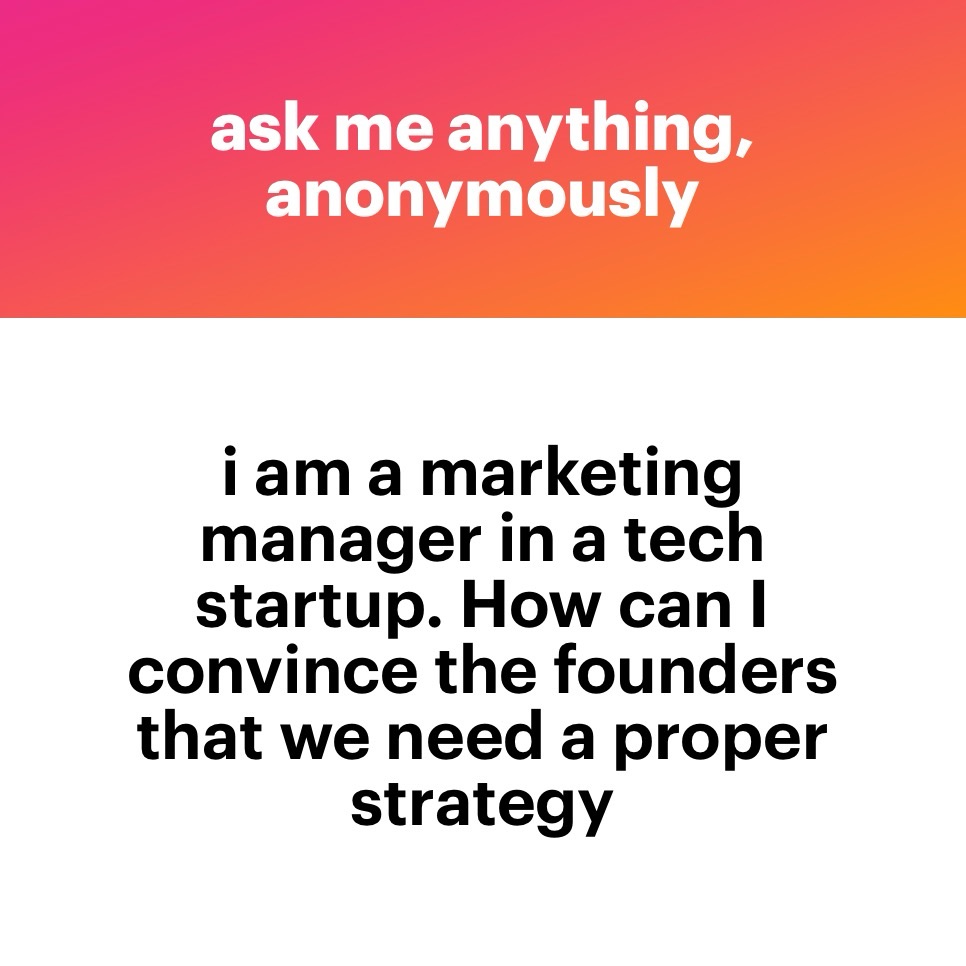
First question is in, and it’s brilliant:

That’s a really tough one. If there was one surefire formula, I’d be rich.

The issue is that startup founders are really hard nuts to crack, for a number of reasons:

  • They tend to be super smart themselves, which can make them sceptical of other people’s expertise, especially when, as founders, they’ve had to do a bit of everything – Marketing, Sales, Bookkeeping, HR… It can make them think they are experts at everything
  • They know their product like no one else (often because they’ve built it themselves), and don’t trust outsiders to represent it accurately
  • If the founder is a techie, scientist, or software engineer, they sometimes don’t fully understand the need for comms. They think their product is brilliant and assume everyone else can see that, too
  • In the early stages they’re often involved in Sales themselves. They may have spoken to customers and heard about their pain points. And they’ll have prepared answers for them. But often, when they scale and make that first marketing hire, they forget to share all that useful knowledge with their marketing person. And then don’t understand why other people just don’t get it.

Now I don’t know if any of the above is the case with your founders. But here are some arguments that have worked for me in the past:

1. The people in your target companies who “get the tech” are usually not the same ones who “have the money”. You need a comms specialist to translate the features of your product into benefits for non-techie budget holders

2. We need to get the narrative out of your head and onto a document so we can all be on the same page on what it is we do, who it’s for, and why they should care. If we don’t do this, our story will be inconsistent, and we won’t be able to scale our marketing efforts (eg brief copywriters who can do some of that work for us)

3. You’re biased. (This one works well with scientists). Because you’re so convinced that your product is amazing, you can be blind to the reasons why buyers may be sceptical, the workarounds they’ve learned to live with, and the internal resistance they’re facing. An outsider who understands tech buying processes and audiences, and who has experience poking holes in the story, and asking uncomfortable questions can help us make our story so much stronger.

I’m sure there’s more and I’ll update with other points when I think of them. I hope this has been helpful! (you can drop an anonymous comment to let me know).

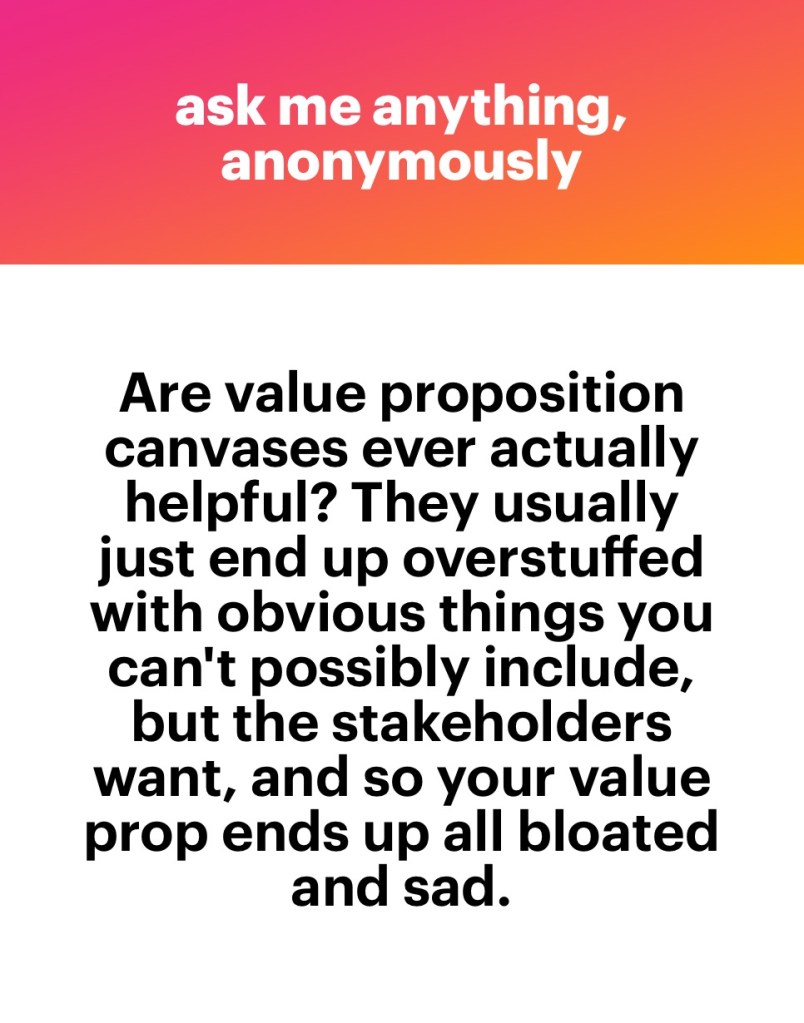
Question #2 is about value proposition canvases

I can hear the frustration in this one. And I share it. To answer it, I’m going to have to make some assumptions:

  1. I’m assuming you’re talking about canvases like the Strategyzer one
  2. I’m assuming you’re talking about the absolute state they end up in after a half-day stakeholder workshop, full of bullets and buzzwords and sticky notes 

And then my answer is absolutely, no, they’re not useful as value propositions. Except:

There are two purposes to a workshop like that. Only one of them is to arrive at a value proposition. The other is to get all the stakeholders into a room, get them to dedicate some brain space to the key questions every business needs to ask itself, and make them feel that they’ve been asked and have been heard. This is hugely useful. Because it gets them on board with the process and limits them in their ability to undermine your efforts further down the line (at least if they don’t want to look like an absolute tool).

The output from a value proposition workshop is not a value proposition. At least not straight away.  It’s a brain dump where you’ve collected – and ideally weighted – the key issues. Now is where the real work starts. In my opinion, good value propositions are not created by committee. The issues need to be ordered, distilled, outliers weeded out, missing information (such as e.g. customer insight) researched and added. Only then do you start copywriting and polishing it.

It also helps to nominate an ultimate decision-maker with whom the buck stops. (Ideally choose someone very senior, decisive and not-too-precious). It’s their job to make the tough calls on points of disagreement, and everybody involved needs to be aware of the importance of this. Because you’re absolutely right: bloated and sad never got no leads excited.

But in summary: if you think as the workshop as at least 40% kum-ba-yah, and of its output as loose materials that give you a starting point, then that messy canvas becomes less frustrating. In my experience, anyway.

I hope my assumptions were right and this was a helpful answer. 

Feel free to get in touch again if not.

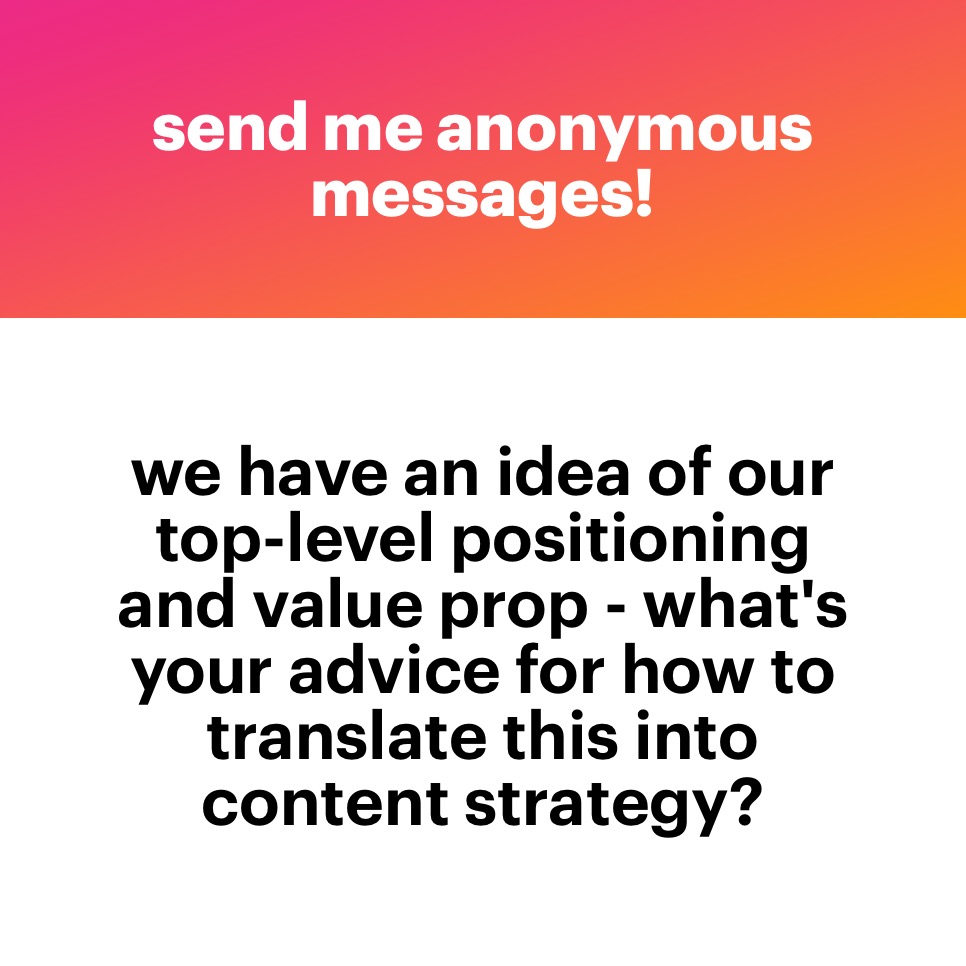
Question 3 is about turning value props into content

Nice one!

My general advice would be that your best content will always come from the things that you know better than anybody else. The things you could actually teach. And that your prospects will care about. Ideally, once you’ve gone through the process of distilling what that is, that has become an essential part of your value proposition, too.

But it’s a hard one to answer in the abstract. So I’ll use an example. Let’s say you’re in the data center business, and you have a number of data centers in the UK that are equipped with such an amazing low latency network that you can reliably power edge applications. That’s already pretty cool. But say you’ve also developed water cooling technology so that your data centers do all this high-performance stuff without costing additional energy to stop your servers sweating.

Then you have that amazing intersection of 

A) Something you know better than anybody else – i.e. more eco-friendly high-performance computing

B) Something your target audience cares about – meeting sustainability goals across their entire business, including in IT operations

And that intersection is where the good content is hidden.

You could now e.g. create content about “net-zero multiplayer gaming” (which combines the edge computing and sustainability themes). Ideally you’d already have a customer in that space that you could showcase, but the beauty of this is that you could even interview the CEO of that gaming company and make them the hero of a blog post or video. Even if you don’t know them. They’re not going to refuse getting to tell their story, and exchanging ideas with a like-minded business. By highlighting their good work, you’re automatically claiming that space, too – without explicitly beating your own drum.

(And then of course you do all the usual content strategy stuff of planning out your hero pieces and different formats, and the channels where your audience hangs out etc).

Thank you for this excellent question!

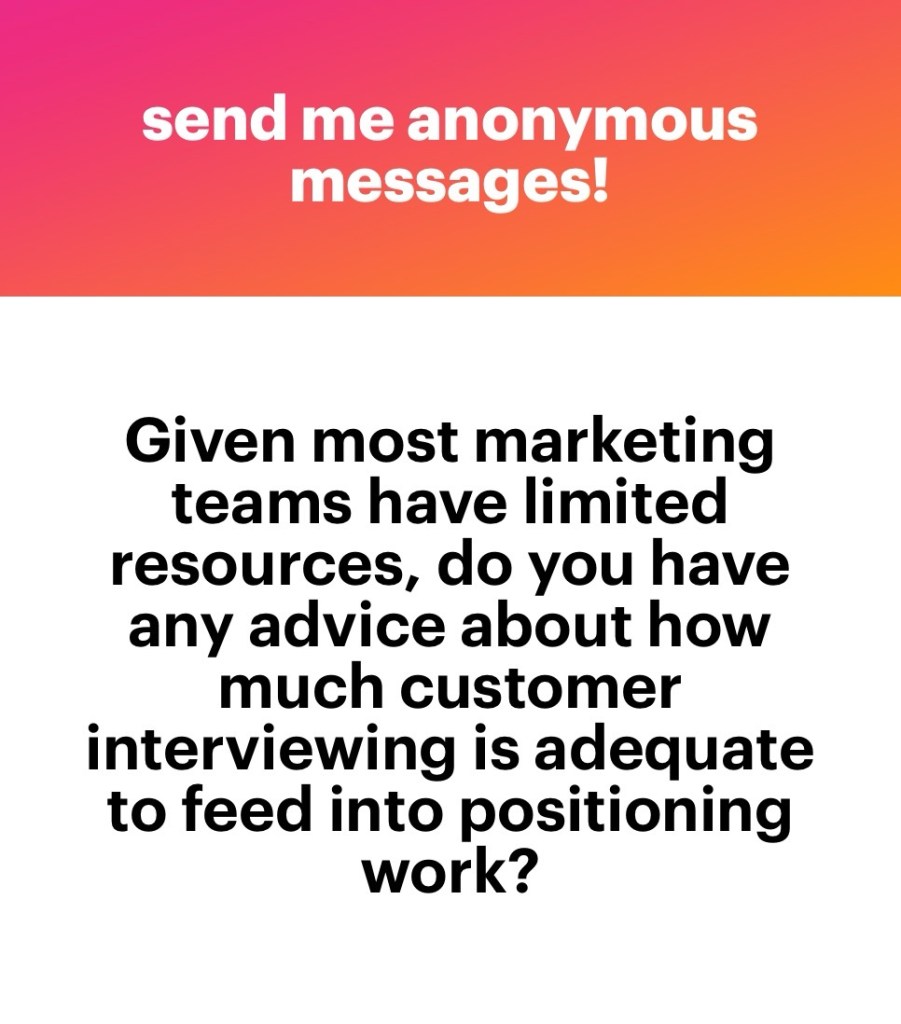
Question 4 is about the voice of the customer

Oh man. Love that somebody asks about this. (You may have seen me post about it on Linkedin the other day). It’s something I keep banging on about. I have worked on a ton of projects where my request to speak to an actual customer was met with blank stares or impatience.

In fact, in my experience it’s not so much the lack of resource that stands in the way of customer insight, but the fact that many marketers don’t understand the importance of it. They’re not always to blame though. In plenty of organisations it’s the salespeople who gatekeep their customers, and they won’t let marketers speak to them. It’s a big problem.

But to answer your question, speak to as many customers as you can for you positioning or value proposition or messaging project, and if you’re in-house, make it a regular ritual to interview customers, especially when things change – eg the market, or your product, or the distribution model, or the competition…

Having said that, there is a point of diminishing returns. For a project I did last year for a services org, I interviewed 10 CIOs of enterprise-sized companies across the world. And while each geography, person and industry reported unique challenges, there was a point around interview #7 where I felt a story emerge, and key elements kept repeating. But this varies from project to project and will also depend on…

  • The newness and complexity of your proposition
  • The attitudes, maturity and appetite of your customer base
  • The number of decision-makers who are typically involved
  • how challenging it is to adopt your product…and so much more.

But as a general rule, if you’re a strategist and you’re told you can’t speak to a customer, raise the alarm with the person who hired you for the job.

Categories
content marketing Copywriting positioning

Grammar, shmammar.

The podcast where I tell the grammar police to do one.

Are you even a copywriter if you don’t faff about all morning only to have to work late to deliver what you promised? If you don’t find typos all over your piece the minute after you hit send? And if your clients don’t regularly point to some bit of your copy being ‘ungrammatical’?

David McGuire – who runs the lovely clutter of copywriters that is Radix Communications – has asked the very smart brand poet Rishi Dastidar to discuss the importance of grammar in B2B copy. And then I say some stuff too because I’m co-hosting.

Listen here if you like that sort of thing. (I won’t because I hate the sound of my own voice. Also, I’ve been told I sound Northern. Don’t tell my Bavarian relatives).

Huge thanks to David for inviting me. I had a blast. Pint on me next time you’re in London. Or Bavaria.

Categories
positioning

My SMB lightbulb moment

Why every marketer’s first job is to get rid of “not for me”

I’ve just finished a B2B positioning and content strategy project with a great client. Their SaaS product is pretty cool: it helps small and medium-sized manufacturers digitally track their production and collect data on everything they do. While I was working on it, I realised a very basic thing. So basic, in fact, that it looks incredibly dumb when I write it down. But it ended up being one of the key insights for our messaging.

It’s this:

If your product is for SMBs, you should say so loud and clear.

I told you it was basic. But: this dumb fact is really important. And the reason, I think, is that most small and medium businesses (SMBs) suffer from some kind of impostor syndrome. Or a business-world version of it. I’ll try to explain:

  1. Most SMBs think they’re too small to buy any of the tech that’s on the market. Because it’s not made for them, and likely too expensive.
  2. They think they’re not sophisticated enough to use it. Both in terms of digital maturity (especially in manufacturing, where a *lot* of stuff is still done by hand, on paper) and team resources (they don’t have IT departments, or IT procurement expertise. Someone in the business will make IT their job – in addition to the day job).
  3. They think they’re, well, special. A lot of SMBs have grown organically, figured things out themselves, learned along the way, made it work. They haven’t arrived at best practice. They’ve found a practice that works best for them. That creates a half-apologetic, half-proud sentiment: “we don’t now how we did it, but it seems to be working. We do things differently here and our processes are unique.” That means they’ll be wary of SaaS-y tech that’s not highly customised to them. “It can’t possibly work for us, can it?”
  4. They’re worried about the disruption it’ll cause. The thought of implementing new tech and teaching workers to use it causes them ulcers. Because if you break the process, it could take ages to put it back together. And that might well jeopardise their business.

All of these cause SMBs to believe that if they did buy a piece of tech, they’d probably be mis-sold an expensive solution, considered a minor customer by the vendor, be neglected by their customer service, and have to figure it all out themselves.

SMBs didn’t just make this up

I hate to say it, but they may not be wrong. According to the World Economic Forum, tech vendors are less willing to invest in development for smaller firms. It seems that for tech companies that are going after the enterprise market – which *disclaimer* I work with most of the time – SMB can be a bit of a dirty word. For them, visions are where it’s at.

Enterprise marketing loves a vision. Of consolidated, usable, analytics-ready data maybe, or of 360-degree customer insights; of processes so frictionless they’re positively slippery; or of raving brand advocates, and of employees with life/work balances so in equilibrium they’re dancing on their desks.

But underneath those visions are some big assumptions: for instance, that your prospects have IT departments who can dedicate resources to integration; that your budget can accommodate months and months of professional services engagements; that the project will be championed by a senior leader who’ll drive the change and communicate it successfully up to the C-suite and down into the business. In short: that there will be the people, processes and budgets to get rid of any obstacles you might encounter.

Needless to say, for a target audience that isn’t used to any tech ever being made with them in mind, the first thing vision-led marketing will do is drive them away. Because for SMBs, all of the above screams “It’s not for me. I don’t have any of those things.”

Lazy marketing can hurt your brand

I believe that the visionary style of marketing has become so pervasive, it’s the default mode for most B2B tech. I’m guilty of it, too. After all, it’s a lot sexier to talk about the great things you’ll be able to do eventually, than about the long, hard slog it’ll take to get there. It’s probably easier, too.

But, if we as marketers are really honest about it, by deploying the vision strategy, we’re systematically excluding SMBs, who aren’t shiny, slick and corporate. They’re often a little grubby, cobbled-together, and managing to stay in business successfully despite it all.

And they’ve come to believe that nothing out there is made with them in mind.

So, obviously, if you’ve decided that your best prospects are in the enterprise space, by all means, you should exclude SMBs from your business and marketing model. But if you’re trying to sell to SMBs (and the market potential is huge!), going all in on a vision, while ignoring their specific challenges from your marketing comms is simply not good enough.

You’ve got everything to gain

So what does that mean in practice? For me, as I was building out a messaging hierarchy for my client, it was this:

Unless we understand that there’s this barrier to tech adoption for SMBs, we can communicate all we want about the benefits of our solution to their business. How it will make them more productive, more efficient, more data-savvy, more competitive. But they won’t really listen until we can get rid of this huge doubt that’s still lingering in their minds. That this isn’t really for them.

So before we say anything else, we need to show that this product is made with SMBs in mind. That no business is too small for good tech. That they may have low digital maturity, and that that’s ok. That we don’t expect them to know all this stuff. That we can show them what their roadmap could look like, and that we’ll be there for them along the way. And that they’ll be able to afford it.

And if we manage to do that, we’ve got a real chance at a true differentiator, and the opportunity to open up a massive market of solid, no-bull-shit, and fiercely loyal customers. It may sound a little dumb, and very basic, but I’m convinced: when it comes to marketing tech to SMBs, “this is for you, as you are” beats a lofty futuristic vision every time.