Categories
content marketing

Respectfully, marketing.


If you’re doing ABM, you probably know what your ideal customer looks like. But do you have any idea what your own vendor profile is?

Being a B2B marketing consultant is a privileged position. I get to see so many more businesses from the inside than most people do. Sometimes that means:

  • Witnessing genuinely exciting new technology long before others do
  • Working with super diverse skillsets, from visionary developers to incredible salespeople and brave founders 
  • Getting a real-world overview of “best-practice” marketing strategies and how well they do in the real world.

It can also mean

  • A surprising number of tech companies trying to “create their own category” TM
  • Yet another chaotic agency (and I can tell you that “each dysfunctional agency is dysfunctional in its own way”)
  • A steady flux of vague briefs with fluffy goals

But by far the most unusual quirk of this job is that I sometimes work on ABM programmes that target the same account as a different ABM programme I’ve worked on. So I don’t just work for a lot of different Bs – I often help them sell 2 a small group of other Bs.

For instance: during a recent call, my (new) client X seemed surprised that I knew so much about the ABM account Y they were trying to sell to. I had researched Y for a different ABM project last year and knew how they were structured and what some of their priorities are. To be honest, X actually seemed a bit annoyed that I had worked for another tech company that tried to sell to Y. I believe they felt that I’d worked for the competition. I hadn’t – my other client had a completely different product, and besides, I’m under NDA on all my projects. Anyway, X didn’t seem to see this advance knowledge as a a bonus – even though it meant I already knew the target account well and wouldn’t need long to research them. Maybe they simply hadn’t really thought about it much before.

There aren’t that many ABM-worthy accounts 

But this really shouldn’t have come as a surprise. Think about it: The Microsofts of this world, the Verizons, Nestles, DHLs, Allianzes, BMWs – there are a few gigantic multinational enterprises out there that of course everybody is trying to sell to. (In fact, sometimes they’re trying to sell to each other). They’re huge, they’re mature, global, and complex. And they need to constantly spend money – and not just on enterprise tech – to keep the ship going. Of course others are after that money, too. And just like you, these other B2B tech vendors are going to target at the very minimum:

  • A specific department  – or several (i.e. the primary users of the solution)
  • IT (because they’re going to have to integrate it)
  • Key people in the C-Suite (so they’ll find and sign off the budget – i.e. probably the CIO, and CFO)
  • (and most will fruitlessly attempt to get through to the CEO, too) 

…and ABM targets are bored with this stuff

Understandably, these businesses are really tired of being sold to. As a consequence of being big-ass corporations, they’re being pitched to 24/7. And unfortunately, a lot of the pitches sound exactly the same (I know because my privileged position as a B2B tech marketing strategist means I get to see a lot of them):

  • The value propositions are bland. They often aim high – e.g. they might revolve around abstract concepts like ‘digital transformation’ and ‘customer experience’, but never specify how they deliver these things. That makes the message fluffy, irrelevant, and less than credible (I wrote about the importance of getting messaging altitude and laddering right in this recent post)
  • They lead with non-differentiating messages, such as ‘our product can be customised’ and ‘we deliver superb user experiences’. Don’t get me wrong, these can be great differentiators – but only later on, when they’ve already bought. They’re not great for marketing, because they’re messages everybody can claim, which have to be experienced to be believed. If they’re actually true about your product, then they’re customer retention features, rather than lead conversion ones. Your targets will see them in literally every vendor’s marketing collateral that lands on their desk and believe me, it makes their eyes glaze over.
  • They beat their own drum instead of focusing on their target’s priorities. Too many ABM propositions still talk mostly about the vendor and don’t craft a value proposition that aligns with their prospect’s business goals (even though they often do the hard work of identifying these!). It leaves the target account having to figure out the value to their business themselves (and who’s got the time, brainspace and motivation for that?).
  • Their creative and collateral are weak. I recently advised a client from the English-speaking world who was trying to break into the German market. They showed me the German website and collateral they’d created. Everything was entirely machine-translated and sounded clunky. What signal is that going to send to your new market? Exactly. It says: “we couldn’t be bothered to invest any money. We’re making you do all the work figuring out who we are. And if this doesn’t work we won’t stick around here.”

How to develop a vendor brand that stands out

And frankly, given that if they end up buying from you, they’ll be paying you rather handsome sums, and often on a subscription basis (i.e. recurring revenue, ka-ching!), these businesses can rightfully expect marketing that tries a little harder. This is true whether you’re doing one-to-one ABM or just plain old marketing to a specific customer segment. I would argue that your customisation effort should be proportional to the potential return you’re expecting. Or in other words:

If it’s going to be valuable to you, it’ll have to cost you something.

And by that I don’t necessarily mean glossy campaigns or airtime or expensive spokespeople. What I mean is making a real effort to be relevant.  How can vendors do this? By doing quite a few things, actually, and none of them are rocket science:

  • Do your research. Talk to the SMEs in your own company. Find (former) employees of your target account or industry in your network. If you can’t speak to an actual insider in person (do try, though. Can somebody introduce you?), read up on your target account’s strategy, their values and priorities – the bigger the account, the more likely you are to find annual reports, mission statements, CEO presentations, interviews. This is where leaders talk about the big issues for their businesses, and ideally your solution is relevant to that  (even if it’s in a small way. If you acknowledge that and credibly show how you can help, it’ll be appreciated)
  • Make a note of the language they use. This is such a simple trick, but it’s highly effective. Adapt your message by aligning to the way they speak. (Note: this doesn’t mean making things up.) But if, for instance, you use the term “sustainability” in your messaging, and their annual report talks about “ESG”, it makes sense to adapt to the way they think and talk about these things internally. Obvs this is easier in one-to-one ABM programmes, where you can fully focus on a single account. But it also works for industry campaigns where you can tap into domain-specific language and demonstrate that you understand your prospects’ world.
  • Complete the Venn diagram. Once you’ve listened and learned as much as possible, be very honest with yourself and probe your value proposition for something your target audience really cares about. Find that sweet spot between what you can offer and what they need. It’s fine if you can’t help with everything. Be open about that. Don’t fall into the overclaim trap. Be as specific as possible. Nobody believes that a single vendor will deliver “Digital Transformation”. Stick to your guns. Name the precise problem you solve, and how you do it.
  • Respect their intellect and time. Prepare for the skeptical questions any discerning buyer will ask and have answers, proof points, case studies and testimonials ready for them. If you don’t have any of these things yet, work up a confident (but not utopian) projection of ROI (think beyond just money: time saved, employee experience, customer retention etc can all be dimensions of ROI relevant). Sometimes you may have to make assumptions (e.g. about their tech setup, or size of their problem). Usually, as long as you flag that they’re assumptions, buyers are fine with that. But: be ready to pivot.

Ultimately, in my experience, being a great vendor comes down to showing you’re respectful and invested: doing the hard work for your prospects, making your message as relevant, compelling and easy to understand as possible, empathising with their position, and helping them apply the due diligence that their business expects of them.

Even better if you do it with wit and verve. But in B2B tech, wit and verve alone won’t save you if you’re trying to cut through to the smart, busy, inundated buyers everybody’s trying to reach. 

(This post is partially inspired by a person, who, when I recommended a messaging exercise to sharpen their painfully generic value proposition, told me that wouldn’t be necessary: the company already had one, it was all there on paper. And if I really needed to tweak it, which they doubted, to do it based on some desk research, and not rock any boats. After all, their customers and SMEs were too important to speak to some random marketing lady. I hope the fact that they “deliver Digital Transformation”, “strive for excellence” and “tailor their services to customer needs” strikes a chord with their audience.)


Categories
content marketing

How to create B2B content that helps you sell


Several years ago ( I think it was pre-Covid *cough*), I did a presentation on content marketing to the portfolio companies of Illuminate Financial (a VC dedicated to Fintech and enterprise tech). Afterwards, they interviewed me for a blog post.
I just found that interview again, and am surprised that I still believe most of what I said then: mainly, that good marketing in B2B isn’t rocket science, and that good content can deliver credibility for your business. (And that you can shamelessly re-purpose old content if it’s still relevant ;)

What is the context and background of what you do?

I help businesses sell to other businesses. My focus is marketing strategy for tech companies – specifically helping them figure out the best message to put to their audience within their market and space.  

In the B2B tech space this is often a big challenge as it’s something that sits at the intersection of understanding product, the overall market, and the audience. 

Too often you see tech companies who are incredibly strong when it comes to building their product, but they don’t have enough understanding of the environment they are selling into. For their proposition to resonate with the industry budget holders (often different from the end users), it needs to be positioned in a way that factors in the different dynamics and forces at play. This nuance is key to the message. It needs to focus on who you are selling to, and the world they are in. 

How can you work out if someone (new hire or agency) really knows B2B?

The first thing I would do is look at the work that person or agency has done in the past. Have they got experience in your sector, and do you like their style? And secondly: Be rigorous when you ask them about their process – get them to take you through it step by step. How do they approach learning about the problem and product, identifying the audience they are trying to reach, and factor this into their work. Make sure you understand what they are doing and why. Don’t let them bamboozle you with marketing jargon. If you don’t understand something, ask.

Why content marketing?

Content shouldn’t be separate from the rest of your marketing. I think marketing disciplines need to work together. I have seen businesses who have split digital, traditional, content marketing etc into silos and it can be a disaster (and it’s not efficient either!). You need to have a clear position and voice as the starting point for all your marketing. Content builds your credibility and authority in your chosen space. It allows your audience to read what you have got to say, self-educate and build trust in you. That’s why it’s so valuable –it helps find people not on your radar and bring them into your orbit. It’s out there working for you when you don’t even realise! But it’s closely related to your value proposition, your brand and your product – these things have to makes sense together.

And, to get it right, it’s essential to lead with the bigger themes in your market rather than the product message. If you only talk about yourself, your prospects will just shut down and stop listening. You need to earn the right to sell to them by showing them you get their world, and the challenges they face. 

Biggest mistakes you see companies make with content?

Leading with a product message is the first. Other mistakes are companies who push out content for content’s sake. Too many firms think they need to publish once or twice a week for consistency. When they do this, they often creep into pushing out posts that either don’t relate to their expertise, or are low quality – or boring! This destroys credibility and traction, which is exactly the opposite of what you’re trying to do.

The other trap is when you have PR masquerading as content. ‘Content’ that is too self-centred, an excuse to write about a client win or award, etc. Don’t make your content library a PR catalogue. No-one will come to your site to read about how great you are. 

Last but not least – don’t put out content that you wouldn’t want to read yourself! Use this as a sense check before you hit post. Are you saying something new and interesting? Is it formatted in an easy to read way? Can I skim it and get the gist? Ask yourself – would a mildly interested observer want to read this (be really honest with yourself…). If the answer is no, then don’t post it.   

What advice would you give to a company just starting? What is the minimum base you need?

The first thing to do as a tech marketer (if you are new hire in a company), is to gain the trust of the techies. The best content will always come from the expertise in the business. One way to create content and gain internal trust is to engage people internally to help create content. Ask people to write a post or interview them about their expertise. It is a great first step to make people internally feel involved, and bridges the gap between marketing and tech. It won’t cost you anything extra either if you are running on a tight budget. 

What about your views on agency or non-agency? Consultants vs in house?

Why wouldn’t you want to work with an agency if you can afford it? They can combine so many things and have a roster of talented people under one roof. Of course, it comes at a price. So working out the best route for your company is common sense. There are certain functions any business should have in-house these days – a good digital marketer for instance – because you want to own your own marketing data. 

What agencies can bring is professionalism and creativity. A way of looking at things differently given what they are exposed to cross industry. There is a lot of B2B content that just looks the same. As though someone created a template and its been shared with too many people. This can be boring and risk falling into the content for content’s sake bucket. Agencies can help create standout visuals, brand messaging, and tone of voice. At the beginning, you can do lots of this work with freelancers to fit your budget but ultimately this won’t scale. 

What are some of the other hacks you would suggest aside from using freelancers?

Getting the foundations right and building from that will save you lots of money and headaches in the long run. As a starting point, I would be hiring a great digital marketer who understands KPIs and measurement. Lots of B2B marketing is experimenting with channels and messages. Which emails are opened, AB testing etc… try to embrace this. Get someone into your team who is excited about it, can set it up, and measure it. This would probably be one of first hires you should think about (I know I’m shooting myself in the foot here as I’m a content marketer) – but I really don’t think you should outsource digital anymore. 

What about the balance of content you would suggest – top of funnel vs sales and head vs heart?

I think that businesses need to have more emotional content! There is a huge misconception that the B2B buying journey is entirely rational – so the content needs to be all sales-aids, etc. with ROIs, business plans, savings calculators etc. Yes, there is a big rational aspect but there is also a huge emotional element that gets completely overlooked. 

If you have a product that solves a specific problem in an industry, there will be people who feel strongly about it. They will have been frustrated with the problem for years. And finding a solution is a relief. That’s what your marketing should talk about.

In a business, there are also ambitions and politics at play. Maybe the sponsor wants to look good to his/her superiors by finding and backing a solution. 

There are lots of message here that can make people sit up, pay attention and say ‘wow – I didn’t realise this existed’. I think the industry is missing a massive trick here by focusing on rational decision making alone. 

What are the other gaps that you see?

As well as top of the funnel content, there often isn’t much middle of the funnel either. This segment is all about best practice. Content marketing works best when you’re generous to your audience with what you know.. This allows people to self-educate. Too often it becomes too salesy too quickly which is a turn off. 

Being too focused on your company, and not the market is the other gap. In any industry there are four or so thought leaders, experts who blog about industry issues that are well known. Reach out to them! Show them you have an opinion, truly react to what they say. Show you are engaging and part of the space you are selling into.


I really enjoyed this conversation (as you can probably tell, I can talk about this stuff for ages). If you’re relatively new to marketing in B2B, then you might also like this post, which explains some basic terminology.

And if you have a B2B marketing or content-related question, or would like to explore your options, then do get in touch!

Categories
content marketing

Notes on Twee

I’ve written a few thoughts on a distinctly “twee” discourse mode – on social media and elsewhere – that’s, if not dominant, definitely noticeable right now. And about why it can be problematic.

There is a marketing angle, but it felt more like cultural criticism than strictly marketing or strategy-related, so I’ve published it over on Medium. If you’re interested, here’s the link:

https://medium.com/@irene_68410/notes-on-twee-198c31de3225

Categories
content marketing

The Brand-Content-Product Divide

Marketers are masters of silo building, new label creation, and generally acting as if what we did was rocket science. But obfuscation isn’t doing us any favours if we really want to be taken seriously.

It’s annoying when clients think anybody can do marketing. Even in this era of supposedly data-driven everything, some of our colleagues in other departments still think that our job consists in printing logos on pens and mugs.

To combat this attitude – or so I suspect anyway – marketers, empowered by the ever-growing martech landscape, love to come up with new labels and entire sub-disciplines. These things show that what we’re doing is real, and hard:

Thought leadership marketing, Growth marketing, Performance marketing, ABM, Demand Gen and Lead Gen (with these last two, I’ve found that even people who have them in their job title often struggle to define the demarcation line).

Specialisation: good; obfuscation: bad

Now there are three main reasons why you’d need all these different labels to describe your discipline:

  • To pay tribute to the complexity and different skills required to do the job (e.g. as a strategist, I wouldn’t touch performance marketing)
  • To show you’re dealing with a completely new thing (like when search engine optimisation, SEO, became a discipline in its own right)
  • To re-package an existing thing and give it a shiny new coat (e.g. you could argue that PR had become so exclusively focused on contacts over content quality, the giving-away-valuable-insight-for-free attitude of content marketing had to come to the rescue; or that ABM is really just all the principles of B2B marketing done properly, for one juicy prospect)

So my point is not that when new labels in marketing come up, they shouldn’t be taken seriously (well, some of them shouldn’t, really). My point is that they’re all still Marketing, after all:

  1. In any real-world marketing department (and even in large agencies with lots of specialists) there will be significant overlap between these disciplines (and the people doing them)
  2. The overlap is a good thing. E.g. content strategists need to work with performance marketers to learn if their assumptions were right, and to double down on the messaging that works, rather than the one that doesn’t. If we don’t generally pull in the same direction and keep talking to each other, we’re not going to see results. 

So while specialisation, new tech and methodologies are important for the entire discipline of Marketing to be taken more seriously, there’s a downside to the proliferation of labels. They’re confusing for many people, and especially for non-marketers, because they can signal that one fashionable new thing should be favoured over another (even though hardly anybody ever agrees on the definitions). And that I have a real issue with.

The Content/Product/Brand divide

Nowhere is this more infuriating than in the – to my mind – artificial divide between  Content, Brand and Product Marketing. 

If you’ve ever worked with me, you probably know that I first landed in the world of B2B tech when “Content Marketing” was the latest, hottest shit. CMOs everywhere were proclaiming that “content was king”. In order to establish itself as a discipline and justify its existence, content had to differentiate against brand marketing (ie high-faluting, top-level visions) and product (deep-in-the-weeds tech specs). 

Content marketing does this by helping brands “become the authority on what you know better than anyone else”. It makes visible the expertise that exists in a business and turns it into attitude, advice, and “how-to” pieces that 

  • Grab attention with an attitude based on a view of the market
  • Earn trust by demonstrating knowledge of the space
  • Deliver differentiation by showing how product features connect to the above and make the vendor different, and better, than its competitors

It’s easy to see that if you want to do this well, it’s quite complex: it requires a proper positioning, i.e. a thorough understanding of the intricacies of a product and the wider tech stack it operates in; the competitive landscape and categories; the buyers, their preconceptions, and the organisational dynamics they deal with; the appetite of your client to stand out or shake things up; and quite a bit of reading between the lines. These are, and have always been, the basics of good marketing.

The other thing that feels pretty obvious to me is that “Content” really isn’t separable from “Brand” and “Product”, and it’s mad to me that we often act like it is. What you choose to talk about in your content, and the attitude you take, forms part of your brand. And if your content isn’t strongly tied to the expertise conferred by the product you’ve built, it won’t be credible. (The same goes for performance marketing by the way: if your metrics don’t relate to the strategy you’ve built, you’re doing vanity reporting).

Labels change – the principles of good marketing don’t

Today’s hottest shit seems to be Product Marketing. In-house, it pays fantastic salaries, and it’s usually completely separate from Content, which has often been relegated to the production of “thought leadership”. Job descriptions for product marketing roles emphasise positioning skills, competitive landscape analysis, customer insight, and the development of value propositions. That’s cool. These are all the right ideas, but they’re not really new – just packaged up with a new label, and given a slightly different flavour.

What I’m really trying to say is that, since I’ve been in the job, the principles of good marketing haven’t changed. We’ve got a lot more digital tools to produce and measure content, and we’ve developed new, and legitimate disciplines as a result of that. There’s nothing wrong with that. But fundamentally, we’re still trying to get through to the people most likely to buy from us, and land an impactful message, ideally first-time round. In B2B, there’s no shortcut to doing that. You’ve got to put in the work. Changing the label won’t change the effort it takes. And if the labels cause you to build silos and stop you working towards the same goal, then I recommend you stop what you’re doing immediately, go back to first principles and specialise from the center out, not from one discipline in. You won’t regret it.

Categories
content marketing Marketing agencies positioning Strategy

A case study

I worked with a Brilliant copywriting agency to redefine their content strategy

I’ve written tons of case studies for clients, and blog posts on why case studies suck, and presentations full of ideas on how to make them better. But I’ve never done one for my own business – until now.

Is it the best case study I’ve ever written? Probably not. Does it avoid all the mistakes other case studies make? Definitely not. Does it have gazillions in revenue attributed to my work ? Also no. (Not yet, anyway.) But is it for one of the loveliest, most responsive, excitable and great-at–their-jobs clients a consultant could wish for? Absolutely.

Everyone, meet Radix:

Click the link to open the file in a new tab and read it more comfortably

(If you’re looking at this from a phone or tablet, you might only see the ghost of a case study. It rematerialises on desktop, I promise.)

Categories
content marketing Copywriting messaging Strategy

ShmatGPT

What ChatGPT is great for: email invites

Look, you probably don’t need another hot take on whether marketers should be using AI-generated marketing content, by a marketing strategist, but here it is anyway:

I rarely hear anybody talk about the key assumption behind this tedious debate: the assumption that it’s a marketer’s job to produce a lot of content. 

When in fact, it’s the job of marketing to produce good content: ideally genuinely new ideas, presented in a fresh way, that resonate with the people you’re targeting.

From what I’ve seen so far, that’s the opposite of what AI does.

What, actually, is the job of Marketing?

ChatGPT regurgitates things that already exist out there, in ways that already exist out there. Assembling words with the highest likelihood of being used in collocation by the highest number of people. Sometimes, the writing is tolerable. Often, it presents utter shite with a level of confidence I can only aspire to. (George over at Radix has written a fine blog about “AI eating itself” with much more nuance than I can muster).

The output from this exercise is the definition of middling. The literary world’s equivalent of brown. If that’s what you think your marketers’ job is, then go ahead.

In my mind then, you have a completely different problem: that you don’t understand the de-familiarising power of unique words (or images, if you’re using AI for visuals) to help us see well-known things in a new light, or the function they have in engaging audiences, or the blank-everything-else-out effect that a genuinely new idea can have, or the responsibility you have as a brand that targets people to not bore them stiff. And yes, your responsibility to hire and train marketers that understand these things. Who can tell a good headline from bad, who know what a differentiator is, who can brief in and feed back on copy.

If you do understand these things, and still use ChatGPT, then you know that getting the prompts right takes such a level of customisation and tweaking that you might as well use that time to write the damn thing.

A ChatGPT experiment

So far, there’s only one use case I can see where ChatGPT being genuinely helpful, and that’s for functional content that follows a clear template. Invites, sign-up forms, things that have a formula. I’ll give you an example of an instance where ChatGPT has impressed me (and, in red, the bits I loved and the ones where I think it falls flat):

Prompt:

Write a sales email to a prospect in which I invite them to sign up to our webinar on the topic of best practice in Modular ERP. [simply because I had a chat about AI-generated content with an ERP client of mine last week]

What ChatGPT came up with:

Subject: Invitation to Webinar: Best Practices in Modular ERP

Dear [Prospect’s Name],

[it’s great that it signals all the core bits of information that need to be there, such as subject lines and placeholders for names, dates and times. You wouldn’t believe how many emails go out with the essentials missing. Wish it had given me a preview snippet for the email as well, and maybe a second subject line for A/B testing, but it’s pretty good.]

I hope this email finds you well. I wanted to reach out to you because I believe you would find great value in our upcoming webinar on “Best Practices in Modular ERP.”

[“Find great value” is terribly generic. Why/ why for me/what’s the value? Similarly, “finds you well” is tired language, plus double use of “find”. A good editor would spot that.]

In today’s fast-paced business environment, having a flexible and scalable ERP system is crucial for optimizing operations and staying competitive.

[“Today’s fast-paced environment”. I couldn’t believe it went there. The most telling sign of lazy writing. It says you should care but I don’t. It claims urgency without proving it. Absolute no-go. I actually have a voodoo doll in the likeness of that phrase that I stick pins in at night. But: I was impressed that it hit a crucial business benefit of modular ERP. Optimising operations is indeed something a well set up ERP does and I hadn’t briefed that in. I assume that means it’s what everyone says, though. “Staying competitive” is the same as “fast-paced environment”: it’s so generic a benefit – duh – that you should step away from it].

Our webinar will delve into the benefits and strategies of implementing a modular ERP approach, allowing businesses like yours to tailor their systems to meet specific needs and scale efficiently.

[My main issue with this paragraph is that it sounds good at first reading, and then you realise it doesn’t actually say anything. Meet specific needs indeed].

During the webinar, our expert speakers will cover:

  • The advantages of modular ERP over traditional monolithic systems [Loved that word. I suspect everyone uses it or it wouldn’t have made its way into this]
  • Key considerations for selecting and implementing modular ERP solutions
  • Real-world case studies highlighting successful implementations
  • Strategies for maximizing ROI and long-term sustainability [Great work if you can get it, but I hadn’t briefed that in and I’d want to check that I can actually deliver on case studies and ROI before I send this out]

Date: [Insert Date] Time: [Insert Time] Duration: [Insert Duration] [thanks for the reminders, this is useful!]

This webinar presents a unique opportunity to gain valuable insights and actionable strategies directly from industry experts. Plus, it’s completely free to attend. [Love all these AI-generated case studies and experts I don’t have, that really makes my job a lot easier. Wait, what do you mean, free. IT’S NOT FREE. by which I mean, you really gotta check the content of this stuff]

To secure your spot, simply click the link below to register: [Insert Registration Link]

If you have any questions or would like more information, feel free to reach out to me directly. We’re here to support you on your journey towards optimizing your ERP system.

[Switching between “I” and “We” is not a great look, but I do it on this website as well, so I’ll let it go]

We look forward to having you join us for this informative session. [the rule is “Show don’t tell”. That’s for them to find out, not for you to claim.]

Best regards,

[Your Name] [Your Position] [Your Contact Information]

ChatGPT Really isn’t Marketing’s Biggest problem

Okay, so on the whole this wasn’t bad.

I found it too long and generic, but part of that was down to the minimal briefing. If you’re writing a generic format like an invite, my take is you could save yourself a lot of time by getting ChatGPT to write it for you. But only if you then invest the effort into making it good, and importantly, yours. Saying things that are different and new, and unique to your brand. Also maybe injecting a bit of personality into that voice.

What it alerted me to was this: whenever it came up with bits that sounded industry-specific, but were actually too high-level to say anything much, that was a red flag for me: the way the technology works means that it can only have pulled this from existing content about modular ERP and these things must have been the safest common denominator. They’re the most generic things you could possibly say about the topic, and from my marketer’s POV, therefore useless. They don’t contain any differentiators or value propositions, or product features or audience insight – none of the elements that make marketing good, and specific to you. So I guess you could use it as a tool to establish the absolute minimum baseline of what others in your industry are saying. Then pivot the shit away from that.

My TL;DR point though is this:

It’s Marketing’s job to figure out what to say and to whom

…and ChatGPT can’t solve that for you (not yet anyway).

The real problem is that most companies considering ChatGPT have got the job of the marketer all wrong. They burden in-house marketers with producing all this formulaic crap that nobody reads, and they don’t challenge them to make it good, or give them the time to develop genuine differentiators. They literally think they’re in the business of producing words. If, at a time, where formulaic content production cost has hit quite literally zero, they can’t pivot away from that and start seriously re-considering the job of the marketer, I can only hope the market will punish them.

If, however, it makes them realise that the marketer’s job is to think about all the hard things – what we’ve got to say, why we should be saying it, and why people should care – then I, for one, welcome our LLM-powered artificial overlords with open arms.

Categories
content marketing Roundup

2022 Wrapped.

A quick overview that might help my parents understand what I do for a living

2022 was busier than I thought it turns out. And I wouldn’t even know this if I hadn’t pulled the stats – or, let’s be honest, roughly estimated the numbers by going through the folders on my computer.

If you’re keen to know what I’ve been up to all year – or would just like to know what I actually do all day – take a look at this highly data-driven summary of Say What?’s 2022.

Categories
content marketing Copywriting positioning

Grammar, shmammar.

The podcast where I tell the grammar police to do one.

Are you even a copywriter if you don’t faff about all morning only to have to work late to deliver what you promised? If you don’t find typos all over your piece the minute after you hit send? And if your clients don’t regularly point to some bit of your copy being ‘ungrammatical’?

David McGuire – who runs the lovely clutter of copywriters that is Radix Communications – has asked the very smart brand poet Rishi Dastidar to discuss the importance of grammar in B2B copy. And then I say some stuff too because I’m co-hosting.

Listen here if you like that sort of thing. (I won’t because I hate the sound of my own voice. Also, I’ve been told I sound Northern. Don’t tell my Bavarian relatives).

Huge thanks to David for inviting me. I had a blast. Pint on me next time you’re in London. Or Bavaria.

Categories
content marketing Copywriting native advertising

A blast from the past

Some 1980s native advertising from Germany

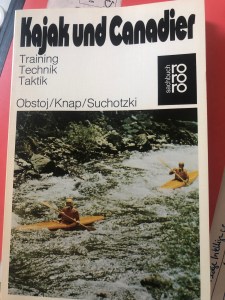
I’m in Germany staying at my parents’ and have just been reminded of a type of native advertising we used to get in paperbacks, like this one.

From this sort of era.

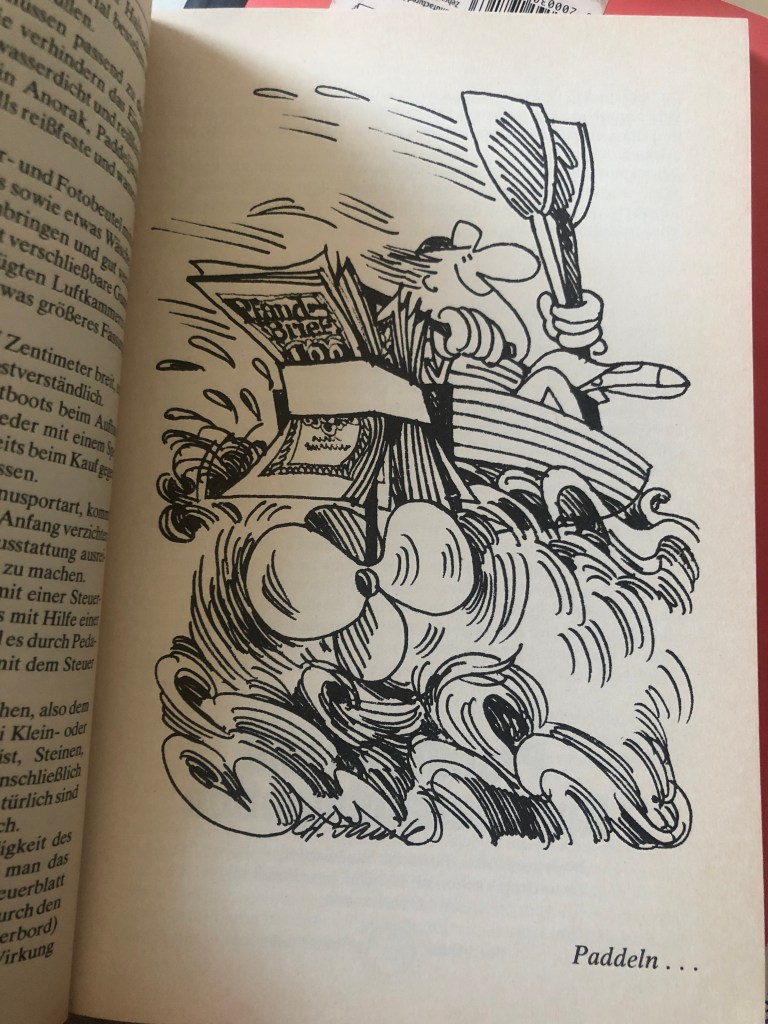
You’d read about kayaking for a bit, and then all of a sudden, you’d come across some bonkers illustration that looks completely different from the others in the book.

The illustration would somehow relate to the topic of the book. In this case, paddling.

And on the next page, the copy would, with some considerable mental gymnastics and loads of metaphors involved (“keep your head above water”, “stay the course”, etc), bring the topic round to municipal bonds and where to buy them.

What I’m taking from this: Native advertising has always been clunky, even when it tried hard. (and didn’t take itself too seriously)

I don’t like the idea of being served an ad in a book I paid money for. And I doubt the ad made the book cheaper for readers to buy.

But 1) The targeting strategy seems solid: people interested in kayaking for pleasure, or even toying with the idea of buying a boat, probably have some disposable income, if only a moderate amount. It makes sense to suggest they invest some of it.

And 2) I love how hard the copy is working here. See the paragraph above (despite the clunk).

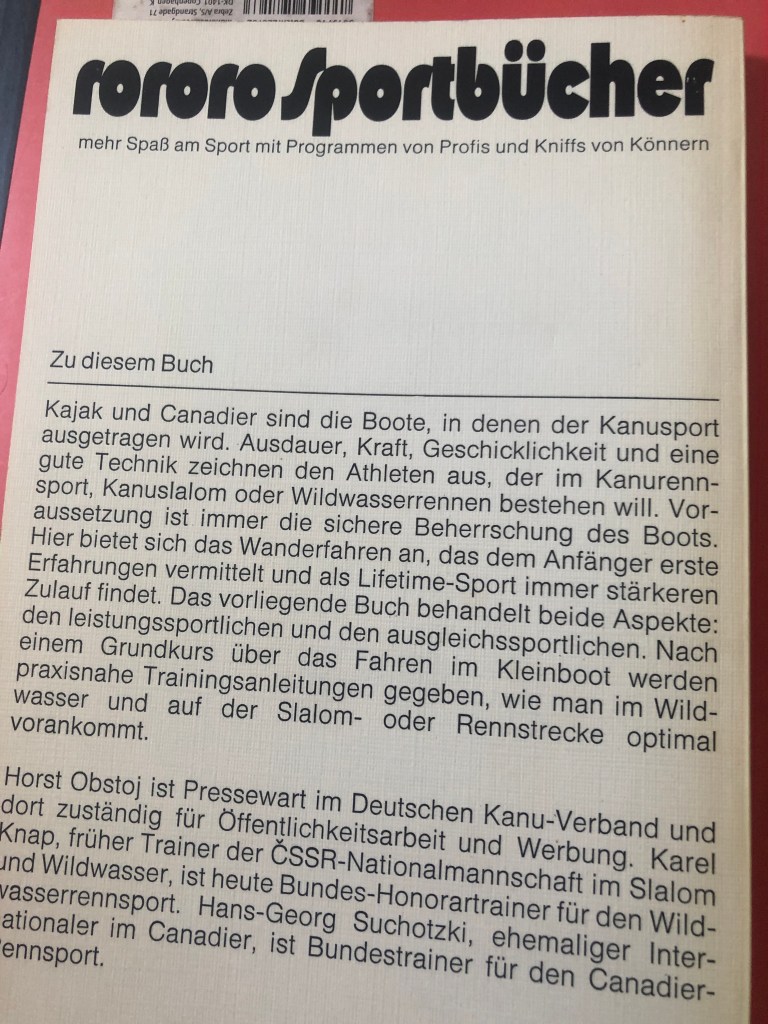
Even better (though not related to the ad): the positioning for this series of sport-related books: “Mehr Spaß am Sport mit Programmen von Profis und Kniffs von Könnern”.

Punch and alliteration go a long way.

I couldn’t find any information about the success of these ads, but they did run for a good 20 years, apparently. And I don’t know how they would have attributed ROI back then. But I’d love to find out how people felt about them. If you’ve got any insights, let me know. But it might take me a while to respond. I’m going kayaking.

Categories
content marketing

Why you can’t just ‘manage’ content

There’s a job title schizophrenia in marketing. But we can fix the titles later. Let’s fix the thinking first.

I first published this post on LinkedIn some time ago (mostly because I didn’t have a website then)but I feel it’s worth repeating here. It talks a lot about how I feel businesses should start thinking about content – which includes never doing content just for content’s sake.

We’ve reached peak content. The point in time where pretty much every company’s verdict is: content seems to work, so we gotta do content, too.

As a consequence, there are tons of ‘content manager’ jobs going round right now. Across the board, businesses are creating these full time roles – hiring people to keep the content machine humming, and manage the creation of blog posts, videos, ebooks, whitepapers, tweets, the lot.

Businesses are asking for an impossible skillset

The problem is: the vast majority of businesses don’t really understand the skills and processes that go into content creation. And that’s why they’re asking for the impossible when hiring for that role. Let me explain:

Go to any job portal, grab a handful of “content manager” job descriptions and you’ll find them as delusional as most client briefs (You know the kind, where the goals are brand awareness, lead gen, uplift in sales, product launch, PR-ability, and a reduced waistline. There’s no budget, the deadline is tomorrow and the target audience is everyone. Oh, and make it go viral, will ya?). You might as well be headhunting a Siberian leprechaun.

Here are just some of the skills you’re supposed to bring:

  • Be a terrific writer and editor (with several years of experience writing for the xyz industry)
  • Know how to create all types of content (video scripts, “thought leadership”, blogs, short’n’snappy, social, long form, interactive, etc)
  • Have knowledge of desktop publishing
  • Be an amazing project manager, scrum master and organisational talent
  • Be able to run the overall content strategy and nail all the messaging
  • Be able to run social media for your business
  • Commission and review content
  • Understand programmatic
  • Be highly creative – but not precious
  • Have a deep understanding of marketing automation
  • Be a digital wizard who’s up to date with martech
  • Run the global roll-out of content campaigns
  • Have a passion for tech
  • Have experience managing budgets and timelines
  • Know how to track and measure a campaign
  • Be a great stakeholder manager
  • Be able to lead and mentor a team of juniors and get senior-level content out of them

Why is that a problem? Because, in more than a decade of agency-side copywriting and strategy, I’ve never met a terrific writer who was also a great project manager. I’ve never come across a marketing automation hero who would have been happy to commission, creative-direct, and proofread a video script. And I’ve rarely met a creative who wasn’t also a bit of a diva, and wouldn’t have been happy to throw all budget considerations overboard once they’d developed a big vision for a campaign. 

Unrealistic expectations of the person and their skillset aren’t the only problem, though. It’s not necessarily the workload either (though reading through some of those job descriptions makes you want to run for the nine-to-five hills). 

It’s the lack of focus apparent in them.

Few businesses can agree what content is, and what job it’s supposed to do for them. And seriously, the last thing anybody needs is more random acts of content. You can see it everywhere: everyone’s “doing content”. Few are doing it well. Most are doing it without a strategy. That’s what creates the famous deluge of crap that Doug Kessler has so articulately written about. We’re about to be buried in it.

The problem with ‘manager’

The only way out of the crap conundrum is a proper strategy: thought-through content concepts, creative direction, outstanding ideas, and editorial rigour. I.e. a plan. And one that allows you to create a few, really good pieces that hit the mark, not just a ton of stuff.

But the problem with the ‘manager’ job title (whether that’s for content or marketing, or content marketing or whatever) is that it pre-supposes that such a plan exists. Something your content manager can run with. And that’s rarely the case – so as a result, these managers often have no choice but to react to each and every request for content from within their business – which exacerbates the crap problem.

And that’s where those fuzzy job descriptions create a real issue, because the people you’re hiring to manage the content aren’t necessarily experienced in building such a plan.

Content management and content strategy are two different jobs.

I’ve been in an in-house content manager role myself. I’ve seen how hard it is to maintain creative and strategic integrity while staying on top of the production, briefing, revision and sign-off processes and fending of people’s requests for yet another “two-pager” for that one use case or prospect. There are two roles in that job: one is a creative and strategic one, the other is operational. And those roles require fundamentally different personalities and working styles. 

From conversations I’ve had with recruiters I’ve learned that they find it easier to fill the role with candidates that can manage content, while it’s a lot harder to find people who’ve been on the creative, strategic and execution side. That’s not a value judgement. As I said, you need both. My point is that whoever you hire, they’ll fall on one or the other side of the spectrum. And that means that you’ll either overwhelm the more operational types with a strategy and execution remit they’ve not been trained for, or you’re frustrating your strategic and creative resources with operational duties they’re likely not very good at and/or don’t enjoy.

And this much is clear: Conflating the two distinct roles in one ‘content manager’ title devalues them both.

So what’s a business to do?

I think for businesses hiring for a content role, the only way to solve this problem is to think hard about what it they really need, and prioritise that. And I believe that the recruiters that work with these businesses need to do the consulting bit and help them narrow that job description.

Here’s how I’d suggest businesses and recruiters should handle this:

Prioritise. Think hard and prioritise what you’re looking for. Do you need an ideas person or a manager? Do you need them to do the work, or to oversee it? Don’t make your job description a dumping ground for all the nice-to-haves.

Buy some outside expertise. If you decide you need a manager, get help with strategy. For instance, you could get a freelance strategist (like me) in for a few weeks to build you a solid plan (or, if you have the budget, get an agency that specialises in content). Their outsider’s view can be hugely valuable for defining your most important messages. It’s their creative capital.

Create the conditions for headspace. If instead you decide you need a strategist, help them manage the processes. A good project, marketing or account manager can keep timelines on track, giving your strategist that much-needed headspace.

Acknowledge and reward the mad skills. And finally, if you’re still set on finding that elusive creature that can do it all: be ready to accept that your recruitment process may take a while, and that you’ll have to pay a premium for a very rare combination of skills.

…And do let me know when you find them. I’d love to have a chat. We might even come up with the right job title for them.