Categories
messaging positioning Strategy tone of voice

The importance of being modest

The case for toning down your claims to delivering business benefits

A very short history of “features vs benefits”

To start off, I want to make clear that I think it’s excellent advice. Here’s the thinking behind it:

Traditionally, tech companies, and especially those with techie founders, tend to focus on product features in their messaging. And while features are one of the most obvious ways to differentiate from the competition, leading with them in marketing comms brings a whole raft of problems:

  • Budget: The only people who quickly understand (and most naturally care about!) a feature are other techies: engineers with deep domain expertise. They are not usually the people with the budget who make purchasing decisions (but they may be important influencers)
  • Relevance: The people who do have the budget are rarely deep subject matter experts – they need help understanding why a feature matters, and why they should care about it. They need it framed as a benefit to avoid a “so what?” reaction
  • Readiness: At an early stage in the sales cycle – when buyers are gathering information and educating themselves – it’s usually too early to talk differentiation on features. The problem at this stage is winning trust by showing you understand your buyers’ world, and articulating the problem you solve for them (such as delays, or error rates, and their impact on the business). Your marketing job at this stage isn’t to sell – it’s to convince the buyer that they need a solution in the first place. It’s only at a later stage that you’ll show them that your solution is different, and better.

So that’s, roughly, where this best-practice advice comes from: to help techie people frame their product as a business solution rather than a technological one. And to show why your solution matters to more people than just its techie users. That’s why, in messaging frameworks, you often see diagrams like this, that ladder up features to benefits (and align them to buyer personas):
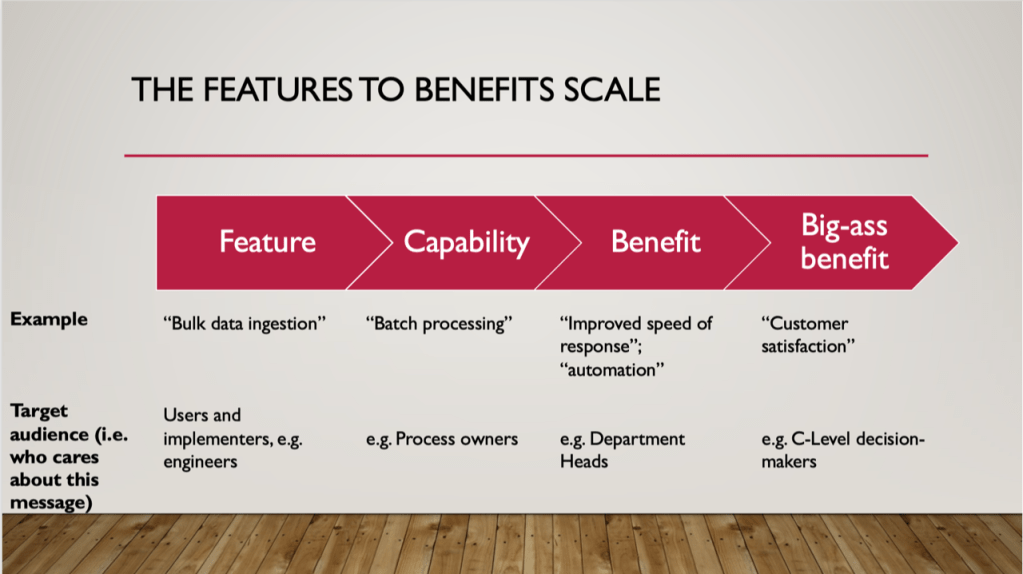
A diagram showing a scale of features to capabilities to benefits to big benefits
This is a very simplified model. For complex products and organisations, you’ll often find many more steps – but it serves to illustrate my point.
The credibility issue

One of the key strengths of this approach has to do with credibility: buyers don’t generally question a vendor’s ability to deliver on a feature, but they may be highly sceptical of lofty claims to a big-ass business benefit (or BABBs, as I lovingly call them). So showing how a feature ladders up to a benefit is a good way to give substance to your claim.

But, I wouldn’t be me if I didn’t have some reservations about the validity of this as universal best practice. As I said above, I don’t think this advice is for everyone. 

The case for modesty

I believe that for a significant number of tech vendors and their products (and especially slick digitally-first startups that haven’t been founded by techies), it pays to be modest: first of all, because claims can be tenuous if not backed up by really solid data (eg “improved customer experience” means nothing if you don’t have the NPS score or something similar to prove it); and secondly, the higher you aim with your BABB (e.g. “Competitive Advantage”), the more abstract you become – and risk claiming everything, and therefore nothing at all. So you need to decide which sort of selling personality you want associated with your brand: data-driven or visionary (I’ll write something about this soon).

And I can think of a few concrete cases when your messaging definitely shouldn’t go all the way to C-Level benefits:

  • When the C-Suite isn’t part of the purchasing decision. I know many clients don’t like to hear this (everyone wants to target the CEO these days!), but be realistic: if you’re not selling mission-critical enterprise systems that can seriously claim strategic relevance, you may have to accept that the CEO will never know that you and your product exist. They may completely delegate the buying process to their IT, user, and procurement departments and ultimately only sign off on the purchase.
  • When you sales team can’t deliver the story: Features-to-benefits messaging is about getting the altitude right and understanding the complexity and nuances of each department involved. A really great sales person can tell the right story to each customer persona AND connect it all to a big business goal, too. It’s a rare skill and not all sales teams can deliver on it. If they can’t, aiming for something like “competitive advantage” in your messaging is likely to feel like overclaim or fluff to your prospects.
  • When you’re in danger of neglecting the core buyer. It’s usually not a good idea to approach an engineer with a big business vision (unless they’re the sort of ambitious go-getter every marketer hopes for but rarely encounters); just like you’re likely to bore a CEO stiff with talk about APIs. On a recent project I worked on, the core buyer was a Head of Digitalisation for HR. As I interviewed them about their challenges, I kept probing for things like “retention rates” and “employee satisfaction”, but they kept talking about inefficient processes. The lesson: If I were to try to sell anything to this person, I’d have to frame it in terms of process improvement, not something bigger and more abstract – or I’d probably lose their interest.
Focus on your best prospect and empower them instead

In all of these cases, it’s a much better strategy to optimise your messaging for your core buyer persona (e.g. the department head) and focus on the benefits and KPIs they care about. I’d recommend having your C-level messages in the back pocket and bringing them up in one-on-one sales conversations rather than in your marketing materials.

And: it’s always a good idea to create a piece of content that enables your champions to sell internally – such as

  • An overview of talking points broken down by buyer group functions
  • A business case template
  • An interactive ROI calculator

Or maybe they’ll ask you for a specific format they know their decision-maker will like. Indulge them and have your marketers fix one up. Having an internal champion deliver your message in your stead to the C-Level is usually much more successful than a direct sales pitch.

TL;DR: stay modest, retain credibility, remain relevant

I want to emphasise that modesty is different from lack of confidence: as a tech brand and product, you should definitely know where you play and confidently claim your space in your market. That includes knowing how you can drive business success for your customers.

But in many cases, the real skill is identifying the core decision-maker first (hint: it’s probably not the CEO!), then aligning your claims to their goals and KPIs. When you do that, good things will happen:

  • You’ll speak to their needs and pain points
  • You’ll credibly show how your solution makes their life easier
  • You’ll demonstrate how you can positively impact the KPIs they themselves are measured on
  • You’ll forge a more natural and credible path to the decisoino-makers

By convincing the key person thoroughly rather than doing a half-arsed job across the board, you ultimately stand a much better chance of selling. This is quiet confidence and it goes a long way.
Categories
Copywriting tone of voice

Notes on tone

Why tone of voice is a stance, not a sprinkle

In this post, I’ll argue that it’s not useful to think of tone of voice as an ornament. Think of it as an attitude instead.

This post has been stewing for a while. Last summer I had some feedback (from an absolutely lovely client) that I found baffling. It led me to sit down and put into words what I believe to be true about tone of voice. I didn’t write it in one go though, which meant that my initial huff dissipated somewhat and my jumbled pile of blog notes ended up sitting in a draft doc for a while because life happened. And one day, as I was browsing through my former employer Velocity’s marketing blog, I saw that Doug Kessler had, of course, already written a piece that said something quite similar to what I was going to say. And had done it beautifully. Damn him.

That made me question whether the idea had ever been mine in the first place, or if maybe I’d already read Doug’s piece but had forgotten about it, and was thinking myself original when I really wasn’t. I didn’t like that thought and ditched the post.

Well, I had lunch with Doug last week and told him about it. He graciously encouraged me to write it anyway. So I did and here you go. (You can find his piece here, but I’d rather you read mine first).

Marketers are latching on to tone of voice – and that’s not always a good thing

Last year, I started working with a new client, who, during our first couple of meetings, kept emphasising how important tone of voice was for them. That they wanted to sound unstuffy and non-academic, and were happy to push the boundaries. That’s great, I thought. Let me at it.

The first couple of pieces I wrote had really low word counts, and not much room to develop any conversational copy while also including all the information that needed to be there. So it was only when I wrote a chunky ebook for them that I realised what they understood “tone of voice” to be.

Let me explain why I think they got it all wrong.

Your readers are tacitly allowing you to sell to them – under the condition that you also provide solid value.

So imagine your standard middle-of-the-funnel type ebook that includes buying advice for its readers – “here’s what you should be looking for when evaluating this kind of software”-type stuff. If you’re a B2B tech copywriter – and even more so if you’re a buyer and regular reader of such content – then you know that this buying advice isn’t entirely impartial. At some point, it will definitely play up a capability that sets the business publishing the ebook apart from its competitors, and emphasise how indispensable it is.

Now I think that’s fair enough. As a reader, you’re aware that it’s a branded ebook given to you by a business with a selling agenda – and you’ll forgive them for trying to sell to you if you still get good stuff out of it. That is if honest, useful advice and deep domain knowledge go along with the selling. It’s the tacit agreement that makes content marketing work. (Bear with me. I’m going somewhere with this).

Now add a sprinkle of tone of voice.

So with this ebook, I had a bigger canvas to develop tone of voice than I’d had with the previous pieces. I aimed for high energy, peer-to-peer, and no-nonsense, and – probably to ingratiate myself with my client – included quite a few phrases that I have now come to think of as “tone of voice cheats” (like calling the reader “you lucky bugger”, referring to software as their “cool new toy” and such. The kind of thing you get loads of from B2C brands like Innocent or Oatly). I hang my head in shame.

Because, as unintended consequences go, these things came to bite me on the bum. As you may have guessed, my client simply loved-loved-loved the cheaty bits – in fact, the main feedback on my copy was to dial those up to eleven – but they cared a lot less for the high-energy, peer-to-peer, and no-nonsense attitude.

They ended up asking me (twice!) to sprinkle in more cute-but-ultimately-hollow expressions. And they also had another amend: they wanted me to remove one particular bit of copy that I felt encapsulated everything we were trying to do with tone of voice in this ebook. It was the phrase in square brackets (x being my client’s category):

Invest in a platform specifically made for x. [We sell such a thing, so of course we would say this – but hear us out.]” 

Their reason for wanting it gone was that “it sounded too salesy”. I found that truly baffling. It’s the opposite of salesy. It’s a wink. It’s acknowledging that there’s a sales agenda, and promising that we’re not going to abuse the privilege of having their attention.

And now that’s exactly where I was going with the above: it’s this stance that I was trying to express with the phrase my client cut. The acknowledgment that both writer and reader are grownups and that we’re not going to bullshit each other. It’s the total opposite of a cheap verbal flourish, and I believe it’s the true essence of tone of voice.

Tone of voice is a stance

Tone of voice is an attitude that expresses how you feel about your audience. It’s made up of the zillion assumptions you make about them: about the world they live in; what they know and what they don’t; why you’re creating content for them; how you think they feel about your business; how much you think they might resist your message; and so on. That makes it incredibly complex. (Which is why it’s also hard to create tone of voice guidelines that are more than crude approximations.)

  • For instance, if you respect your readers’ expertise, you’ll write in a way that takes them seriously, without lecturing them.
  • If you think they’re pressed for time, you’ll keep it short.
  • If you think they might not understand that obscure accounting term you’ve devoted a chapter to, you’ll explain it in a non-jargony way.
  • And if you assume some of them might already have an [x] solution and are highly unlikely to buy yours, you might actually tell them that they’re not your key audience and offer them a kitten meme instead.

Real tone of voice is always there, whether you’re aware of your attitudes or not. It’s not something you sprinkle in after completing draft one. And that means that it can do you a disservice, too, because stance is nearly impossible to fake. Like an old water stain under cheap paint, a not-so-gracious attitude towards your audience (for instance, an overt sales agenda that’s trying to disguise itself) will always come through in your content. For example:

  • If you think your readers are dumb, you might resort to sweeping generalisations in your copy.
  • If you’re trying too hard to be liked, your copy might become cutesy or gymmicky (like mine did).
  • If you’re doing content for content’s sake, your readers will feel your lack of direction.
  • If you’re worried you’ll give away a secret, they’ll feel that you’re holding back on value. (Don’t worry about that by the way. In 99.99% of cases tech marketers aren’t talking about anything their competitors don’t already know).

And the thing is: these are the attitudes that make content deeply unsexy, threadbare, and weak. No amount of sprinkle will change that. Because they mean that you haven’t invested in a stance that’s worth your readers’ while.

So if you want to create impactful copy, make sure you do the hard work: check your knowledge about your audience, where you believe they’re at with their thinking, and how you feel about sharing your expertise. Sprinkles are cheap. Stance is gonna cost you. But it’ll pay, too.